There's a star in the Matchett family tree. A docker's son from Toxteth who topped variety bills for sixty years, played every theatre in Britain, and never once told a dirty joke. Scroll on — the year counter will keep you company.
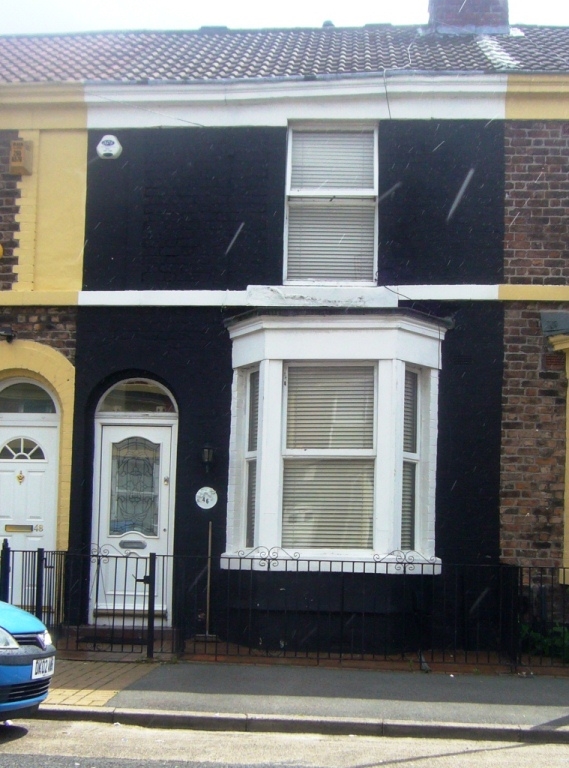
William Charles Matchett was born on 28 August 1889 at 46 Merlin Street, Liverpool 8 — the little terraced house still stands. His father George picked the work gangs on the docks; his mother Margaret died when Billy was twelve, and he and his two younger brothers, George and Henry, were sent to live with their grandmother.
School was Harrington Board in the Dingle — attendance "spasmodic". He left early to earn: odd jobs, the docks (where his father kept passing him over, terrified of being accused of favouritism), five years as a lad in the Liverpool Cotton Market. And, from the start, singing in a minstrel troupe and clowning between reels at the silent-picture houses.
He surfaced in 1909, topping the bill at the Empire, Wakefield, for £6 a week — and was convinced he'd made it. Then this telegram arrived. He wired back "YES", travelled first class, took a good hotel, and presented himself on Saturday for his fifty…
…which was paid in shillings. Two pounds ten. "The management informed him they never wired in pounds." He dined out on that story for the next sixty years.
The proper career followed fast: Liverpool professional debut at the Westminster Music Hall (1912), London the year after, and — at Middlesbrough's Opera House, Christmas 1913 — the first of more than forty pantomimes, nearly always as the Dame. Along the way he'd worked a double act with Bob Moore: "Matchett and Moore."
He served right through 1914–18 in the 6th and 10th (Scottish) King's Liverpool — where one of his officers was a young Basil Rathbone, the future screen Sherlock Holmes. Even mid-war the billing followed him: a St Helens theatre bill from the week of 30 May 1916 advertises "Billy Matchett — the king of mirth from Liverpool."
At the war's end he formed and ran the 55th Division's concert party, "The Roses", then went back every year until 1926 to entertain the British Army of the Rhine at Cologne and Wiesbaden. A surviving photograph shows him in Germany in 1924 beneath a banner carrying his name — six years after the Armistice, a Scouse comic headlining to the occupying army.
In the middle of it all, on 30 August 1915, he married Alice Clayton. Kenneth arrived in 1920, Audrey in 1922, Rhona in 1924 — and the family rented a cottage in Penny Lane, forty years before anyone wrote a song about it.
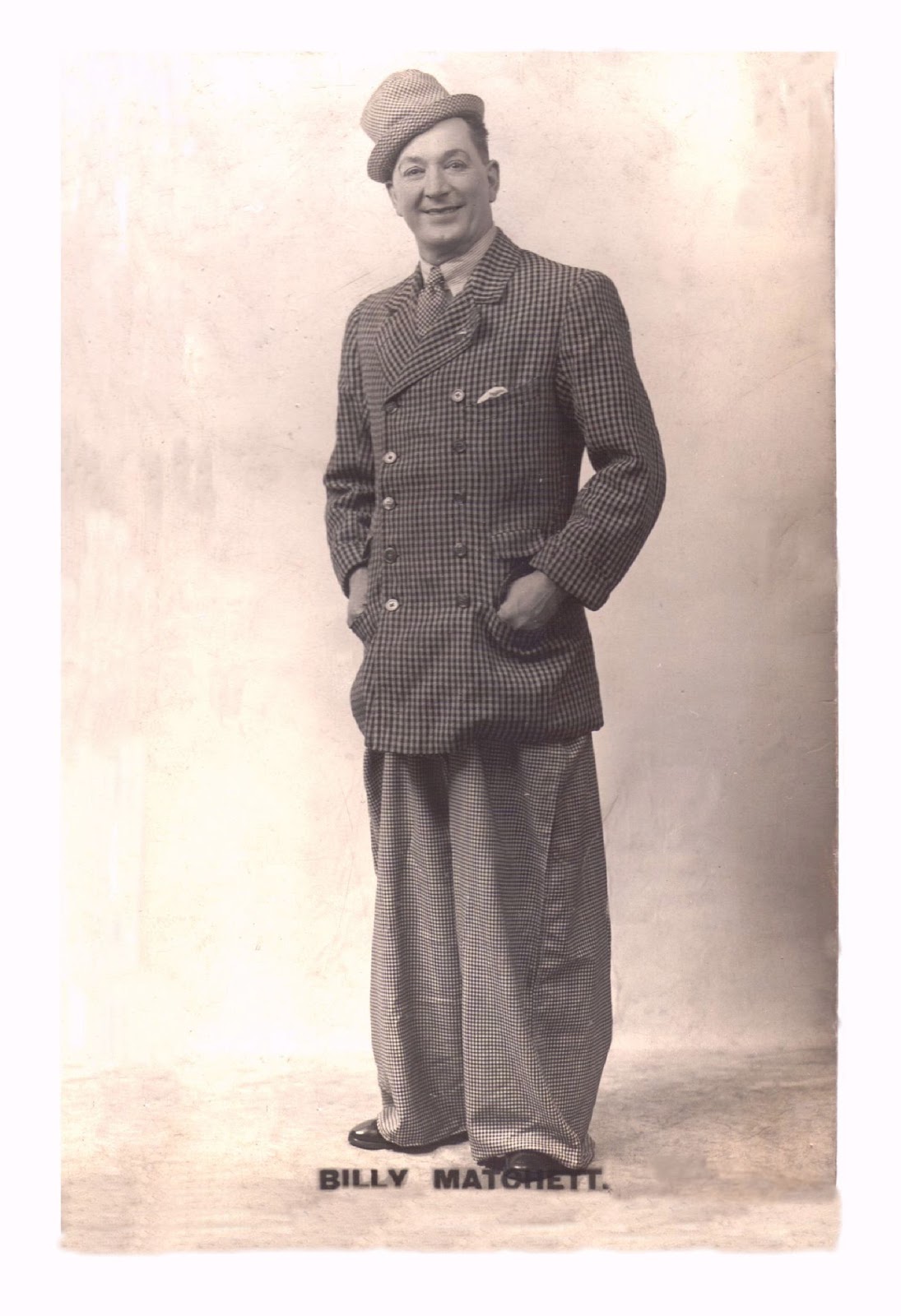
In 1927 Billy made his West End debut as principal comedian in the great Florrie Forde's revue at the Alhambra, Leicester Square. The show was called The Mirthquake — and Billy thought that was far too good a word to leave on the marquee. He took it with him, and for the rest of his life every poster in the land read "BILLY MATCHETT — THE MIRTHQUAKE COMEDIAN."
Except at home. In Liverpool the bills said "Liverpool's Own." In Dublin and Belfast, where they loved him just as much, they cheerfully lied: "Ireland's Own."
The thirties were the big years: road shows with The Two Leslies, summer seasons with Sandy Powell on the Isle of Man, the Moss and Stoll Empire circuits, every seaside resort from Blackpool to Great Yarmouth. Three straight Dick Whittington seasons with Powell — in Hull the programme names Billy's role: Susan the Cook, the Dame. In 1936 he took a pantomime to South Africa with Wee Georgie Wood.
He even made records: in 1934 he and young son Ken recorded "Sandy Joins the Short Shirts" with Sandy Powell — and he's credited as the first performer in England to have a hit with "Does Your Spearmint Lose Its Flavour on the Bedpost Overnight?" — the song Lonnie Donegan revived as "Does Your Chewing Gum…" in 1959.
An original poster from these years — "BILLY MATCHETT / THE MIRTHQUAKE COMEDIAN", City Palace of Varieties, Leeds — now sits in the V&A's national collection.
Through the Second World War he entertained the forces with ENSA — and still squeezed in the day job (Cinderella at the Wolverhampton Grand, 1944/45). After D-Day he followed the armies through Belgium, Holland and Germany, playing to the British Liberation Army in 1945: a 56-year-old comic doing two wars' worth of troop shows, twenty years apart, in some of the same towns.
By now the wireless had made him a household voice too — a regular in John Sharman's Music Hall and, through the forties and fifties, Workers' Playtime, the BBC's lunchtime morale-booster broadcast from factory canteens across the country.
As variety faded, Billy became the definitive "Mr Chairman" of the Old Tyme Music Hall revival — the genial, gavel-banging master of ceremonies, "the genial, beer-swilling Mr Chairman" as the Echo put it, at shows all over the country and on television. Roy Hudd, who saw him work, called him "a Liverpool comic of the old school… all the attack and gusto of the music hall." Ken Dodd named him as an influence.
Two lovely footnotes from these years: in 1959, compering a Bradford talent contest, Billy handed the £25 first prize to a 12-year-old called Pauline Matthews — the future Kiki Dee. And in 1967, aged 78, he was still on tour in "Great Stars of the Music Hall" alongside Hetty King and Adelaide Hall.
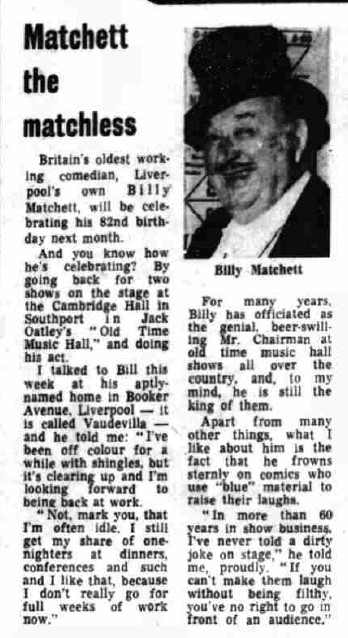
In July 1971 the Echo visited "Vaudevilla" — the house at 165 Booker Avenue he'd named after the profession he loved — and found an 81-year-old shaking off shingles and impatient to get back on stage in Southport. "I still get my share of one-nighters at dinners and conferences," he told them. He was, they noted, Britain's oldest working comedian, and a lifelong Liverpool FC man — one-time honorary president of the supporters' club.
"In more than 60 years in show business, I've never told a dirty joke on stage. If you can't make them laugh without being filthy, you've no right to go in front of an audience."
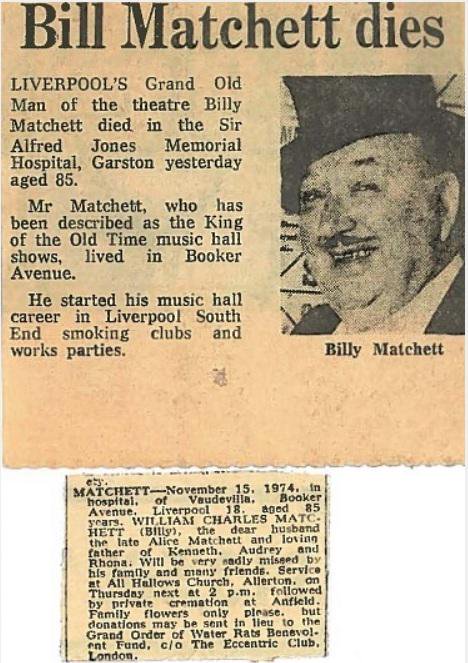
Billy died on 15 November 1974 at the Sir Alfred Jones Memorial Hospital in Garston, aged 85 — widowed since Alice's death in 1962, and working almost to the end. The Echo's headline called him Liverpool's Grand Old Man of the theatre, "the King of the Old Time music hall shows."
The funeral was at All Hallows, Allerton. The death notice asked for no flowers — donations instead to the Grand Order of Water Rats Benevolent Fund. A pro's exit: even the goodbye looked after the profession.